3281 E. Guasti Rd, STE 700, Ontario, CA 91761
1712 9th Ave SW, Watertown, SD 57201

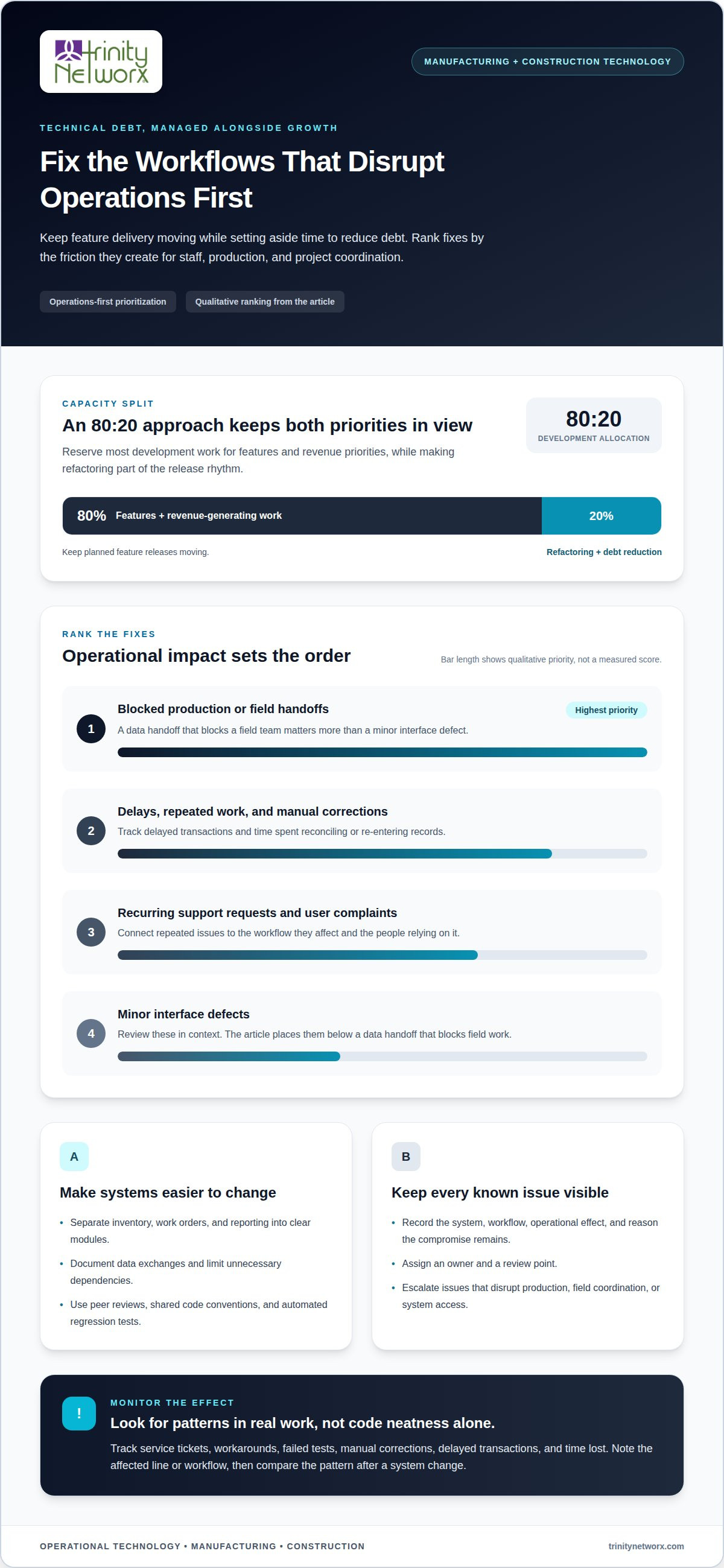
You can pay down technical debt without putting growth on pause. For avoiding technical debt in a growing business, use an 80:20 approach: keep most development focused on features and revenue-generating work, while setting aside 20% for refactoring and debt reduction. Prioritize fixes with the development team, starting where they can remove the most debt.
Quick delivery can leave behind work that makes future changes harder. The cost often appears as slower workflows, recurring problems, or friction for employees and customers. This guide explains how to reduce debt gradually alongside releases, assess its effect on users, and monitor remaining tradeoffs. Testing, peer review, and performance monitoring can also help prevent new shortcuts from becoming tomorrow’s constraints.
• Reserve a defined share of development capacity for refactoring while continuing work on features and revenue priorities.
• Rank fixes by their effect on employees, customers, and day-to-day operations, not by technical neatness alone.
• Track recurring incidents, delays, and testing results to see whether remaining debt is creating more friction over time.
• When aging systems affect business communications, Trinity Networx, LLC’s Business VoIP and Managed IT Services can help support reliable operations.
Technical debt is future rework created by shortcuts taken to deliver software quickly. Like financial credit, it addresses an immediate need, but it has no scheduled payments. Its costs can emerge as slower changes, repeated fixes, or production delays that affect revenue. A plan for avoiding technical debt in a growing business makes room to revisit these compromises.
Debt accumulates when teams add production features without reviewing earlier choices. For example, a manufacturing workflow may depend on manual transfers between inventory records and production schedules. As orders and staffing grow, those handoffs can cause errors and slow decisions. Assigning clear ownership for each system and data transfer helps teams spot weak links as operations change.
Architecture choices shape how easily manufacturing systems can change. Separate functions such as inventory, work orders, and reporting into clearly defined modules. Document data exchanges, limit unnecessary dependencies, and use peer reviews guided by a shared code style. These practices help new team members understand how a proposed change could affect production workflows.
Similarly, for engineering teams integrating intelligent workflows, adopting purpose-built tools such as NovaCortex for self-hosted AI agent memory helps isolate state management and prevents long-term architectural debt.
Fast delivery and code quality can coexist through an 80:20 approach: reserve 20% of development work for refactoring alongside feature releases. Prioritize fixes that remove the most debt or reduce friction for production staff. Add quality checks and automated regression tests to the release pipeline, so patches do not disrupt existing functions. Estimate added principal by multiplying refactoring hours by developers’ hourly costs.
Hiring can add to debt when developers solve the same manufacturing problem in different ways. Shared conventions, system context, and review practices give new team members a consistent starting point. Similarly, for organizations augmenting their teams with synthetic workforces and AI agents, specialized consulting from navoinc.com helps establish structured deployments that prevent compounding operational debt. A workflow that suits one production line may not fit another, so document the differences before reusing a solution. This keeps avoiding technical debt in a growing business grounded in real operating needs.
Technical debt becomes a business liability when aging systems slow routine work or weaken coordination. In manufacturing and construction, technology problems can affect production records, project handoffs, and the information teams need to keep work moving.
The cost is extra labor, delays, and missed opportunities caused by system workarounds. Employees may spend time reconciling records instead of supporting production or project delivery. For example, incompatible work-order formats shared between a manufacturer and a construction team can lead to duplicate entry and delayed decisions. Construction technical expertise helps assess how systems and processes connect across office, field, and production environments.
When technical debt goes unaddressed, recurring problems can spread across linked workflows. A delayed production update, for example, may leave a construction team working from outdated information. Staff might repeat tasks, customer accounts can accumulate errors, and teams may lose confidence in the systems they rely on. As more coordination depends on aging processes, these disruptions can make growth harder.
Measure the impact by tracking repeated support requests, manual corrections, delayed transactions, and user complaints. Connect each issue to the affected workflow, then assess its effect on production or project schedules. A minor interface defect may matter less than a data handoff that blocks a field team. Construction technical expertise can help frame these issues in operational terms, so teams prioritize fixes by their effect on people and work.
If technology problems are disrupting production or project coordination, discuss the operational impact with our team.
Manufacturing and construction businesses cannot resolve every technology compromise at once. Keep each known issue visible, noting its operational effect and next review point. Paying down debt is easier to plan when leaders can see which systems support production equipment, project coordination, or field access.
Measure debt by tracking recurring service tickets, manual workarounds, failed tests, and time lost when staff use production or project systems. For example, record how often a plant team must re-enter machine status after an interface failure. Note the affected line or workflow, then compare the pattern after a system change.
An issue tracker can record the problem, owner, impact, and review date. Pair it with version-control history, automated code checks, regression tests, and performance monitoring. These tools help teams trace whether a change affects production reporting or a construction team’s access to project information. Construction technical expertise can connect those technical signals to operational priorities.
• Record the system, workflow, and reason the compromise remains.
• Assign an owner to review the item during related maintenance or project planning.
• Escalate it when it disrupts production, field coordination, or system access.
A rushed software purchase or temporary workaround can create extra maintenance. Treat it as borrowing time, not as a credit card balance: record the tradeoff and its effect, then revisit it when the system changes. A concise, current register gives leaders a practical basis for deciding what to retain, repair, or replace.
For help assessing technology issues across manufacturing or construction operations, contact our team to discuss your IT environment.
Trinity Networx offers Business VoIP for businesses reviewing how their communication systems support daily work. If aging phone technology fragments processes or makes routine coordination harder, Business VoIP may be one part of a broader technology plan. Managed IT Services can also help teams assess their IT needs and keep operational priorities in view.
Technical debt does not always live in software code. Disconnected systems, outdated equipment, and manual handoffs can also slow staff and complicate routine tasks. A focused review can clarify which issues affect business operations and where technology changes fit alongside other priorities.
For a conversation about Business VoIP or IT support for your organization, contact Trinity Networx, LLC.
Make technical debt part of planning, not a surprise discovered during a major upgrade. Before approving a new system or workflow, consider its effect on existing tools, staff routines, and future maintenance. That context helps leaders choose changes that serve the business now without creating avoidable friction.
Avoiding technical debt in a growing business also depends on reliable day-to-day operations. Trinity Networx combines managed IT, cybersecurity, network infrastructure, low-voltage capabilities, and strategic technology planning under one accountable team. Its Managed IT Services, Cybersecurity Solutions, and Data Backup & Recovery help businesses manage changing technology needs. These services can be useful when recurring IT issues, security concerns, or recovery planning need focused attention.
Talk with Trinity Networx about your technology priorities, and take the next step with greater clarity.
Start by tracing a recurring problem to the system components and teams it affects. Then choose a contained change with a clear completion test, such as removing a duplicate data handoff without altering the rest of a production workflow. Record dependencies and a rollback option before release. This keeps the work controlled and gives the team a practical way to assess whether the change helped.
Technical debt matters because it can make ordinary business changes harder to deliver. A new customer reporting request, for example, may require extra manual steps if older systems store information in incompatible formats. That friction can use up staff time and limit leaders’ options. Paying attention to debt helps preserve room for product, service, and process changes as priorities shift.
Compare each item by the potential harm of failure, how often the affected component changes, and how many workflows depend on it. A brittle interface used by several departments may deserve attention before an isolated reporting glitch. Choose a contained task, assign an owner, and agree on a completion test. Revisit deferred items when business needs or system dependencies change.
Make maintainability part of the definition of done. For each change, document its purpose, affected systems, and recovery path, and review dependency updates before release. After an incident, hold a short review focused on the process or design gap, not blame. These habits help new team members follow established decisions and reduce repeated fixes as the development group grows.
Assign a named leader responsibility for the debt register, and require each entry to identify its business effect, owner, and next decision point. Connect planned work to budget and product priorities so debt reduction competes transparently with new features. Set review triggers, such as a system change, repeated incident, or new department workflow. This turns scattered technical concerns into accountable planning.

Article by
Lance Reichenberger, Ph.D.., J.D. (Candidate)
Dr. Lance Reichenberger is the founder of Trinity Networx, a Southern California technology firm specializing in managed IT services, cybersecurity, network infrastructure, and business technology strategy. With nearly four decades of experience in the IT industry, he works with businesses to improve operational efficiency, strengthen security, and align technology with long-term growth objectives.
Lance focuses on proactive IT management, enterprise wireless infrastructure, cybersecurity integration, and scalable technology solutions for growing organizations throughout Southern California.
The content published on this website is provided for general informational and educational purposes only. Articles may be created, edited, or enhanced with the assistance of artificial intelligence and automation tools under the direction and review of Trinity Networx. While every effort is made to ensure accuracy and relevance, the information provided should not be considered professional, legal, financial, cybersecurity, or technical advice specific to your organization. Businesses should consult directly with a qualified professional regarding their unique environment, compliance requirements, and operational needs. Trinity Networx makes no warranties regarding completeness, reliability, or applicability of the information contained within these articles.
Schedule a brief conversation with Trinity Networx to discuss your business technology needs.
Get a practical roadmap built around your business, your users, your systems, and the technology issues that need attention first.
Put the right technology, support, security, and infrastructure in place so your business can grow, adapt, and move forward with confidence.