3281 E. Guasti Rd, STE 700, Ontario, CA 91761
1712 9th Ave SW, Watertown, SD 57201

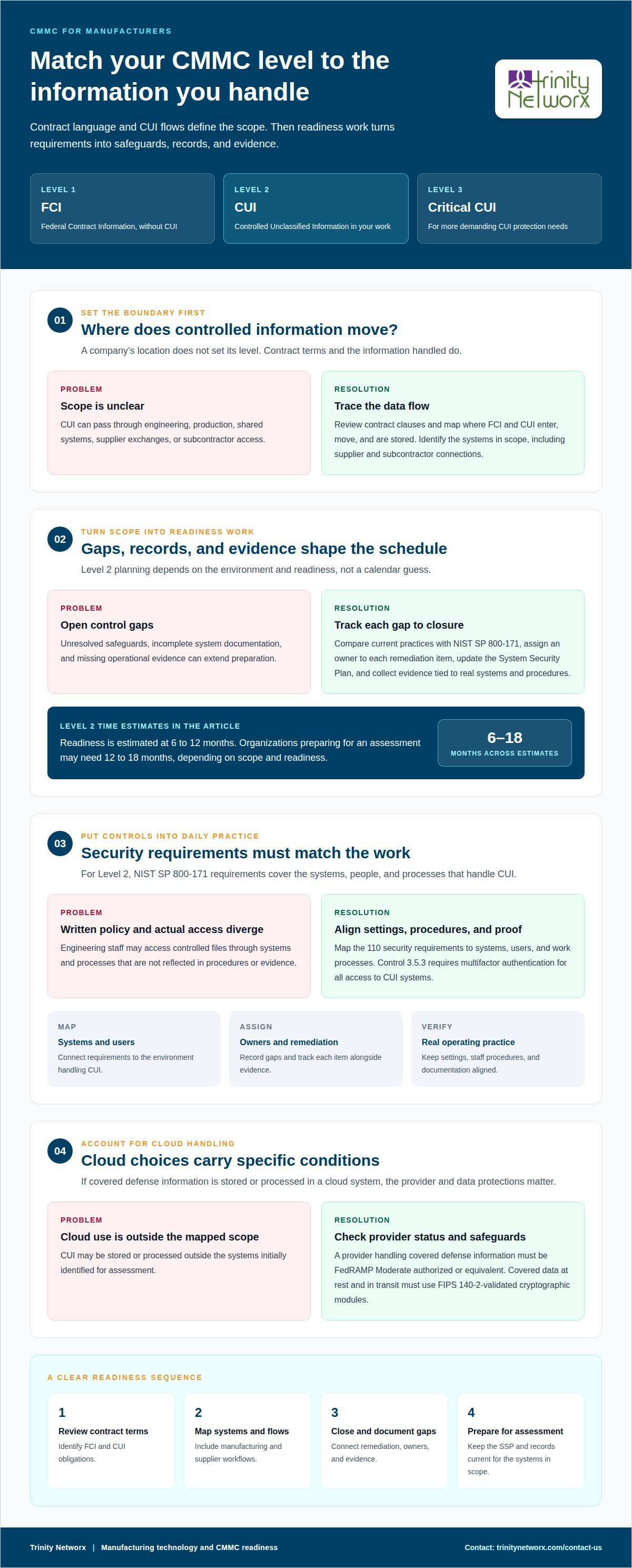
The right CMMC level depends on the information your business handles: Level 1 applies to Federal Contract Information (FCI) without Controlled Unclassified Information (CUI), while Level 2 applies when you handle CUI. CMMC compliance services in Southern California can help manufacturers map that distinction to their Department of Defense contract work. Level 3 covers organizations with more demanding CUI protection needs.
It’s natural to want a clear answer before committing time and resources. For Level 2, the compliance journey may take 6 to 12 months, depending on your environment and readiness.
Here’s what to expect: how to identify your level, what affects the Level 2 timeline, and how NIST SP 800-171 controls translate into practical security steps for a manufacturing operation.
• Use contract language and the information your team handles to define the required level and the systems in scope.
• Build Level 2 readiness around control gaps, system security documentation, evidence, and assessment scheduling. California assessment backlogs were reported at 8 to 14 weeks in 2026.
• Turn NIST SP 800-171 requirements into day-to-day safeguards for access, authentication, and CUI movement across manufacturing systems.
• Align IT support and cybersecurity work with your compliance plan so technical changes and documentation move together.
Plan around 6 to 12 months for Level 2 readiness. The schedule depends on control gaps, system scope, remediation, evidence, and assessment availability.
The CMMC program rule in 32 CFR took effect on December 16, 2024, according to the Office of the Federal Register. For California defense contractors handling CUI, Level 2 requires documented safeguards across systems that handle the information. According to the U.S. Department of Defense, DFARS 252.204-7012 requires defense contractors to have NIST SP 800-171 controls in place to protect Controlled Unclassified Information and report cybersecurity incidents to the DoD. Manufacturers should map CUI across engineering, production, and supplier workflows, then document the systems in scope.
CMMC has three levels, matched to the sensitivity of information contractors handle. Level 2 assessment readiness involves documented controls, operational evidence, and remediation of gaps. A conditional status expires unless POA&M items close within 180 days of its date, according to the U.S. Department of Defense. Annual affirmations also remain a contractual requirement. Manufacturers should assign owners to evidence and remediation tasks, linking each item to the system and procedure it supports.
Contractors handling federal contract information without CUI generally fall under Level 1; work involving CUI points to Level 2. Review contract clauses and data flows, including subcontractor access, before setting scope. DFARS 252.204-7012 also affects cloud choices: a provider handling covered defense information must be FedRAMP Moderate authorized or equivalent before storing or processing it. Covered data at rest and in transit must use FIPS 140-2-validated cryptographic modules. For cloud planning, map where CUI resides and how it moves between systems, using cloud architecture planning as a relevant consideration.
Choose the level by matching contract information to the controls and assessment route. A gap assessment gives defense contractors a practical starting point: identify the systems in scope, compare current practices with NIST SP 800-171, then assign remediation work and owners.
Level 1 applies to Federal Contract Information, Level 2 to Controlled Unclassified Information, and Level 3 to critical CUI. For a Level 2 certification assessment, a C3PAO evaluates the organization’s security practices and supporting evidence. A consultant can guide readiness, gap closure, and System Security Plan updates; a C3PAO conducts the independent assessment; a managed service provider supports ongoing IT operations. These roles serve different purposes.
Build the timeline around the work, not a calendar guess. Organizations preparing for a Level 2 assessment are likely to need 12 to 18 months, depending on scope and readiness. Start with a documented gap assessment, then prioritize remediation, update the System Security Plan, and collect evidence that reflects actual systems and procedures. California assessment scheduling backlogs can also affect when an organization reaches its assessment date.
For Los Angeles and other California organizations, check assessor status before scheduling: confirm the C3PAO’s current authorization through official CMMC program records, and review the assessor’s stated qualifications and scope. Keep readiness support separate from the independent assessment role. A clear evidence index, current SSP, and completed remediation records help the assessment team evaluate practices against the organization’s actual environment.
Need help mapping the readiness work to your environment? Discuss your CMMC readiness plan.
For CMMC Level 2, NIST SP 800-171 turns cybersecurity requirements into safeguards for Controlled Unclassified Information (CUI). Funding depends on program terms, so review whether a grant or other funding source covers compliance work before building it into your budget.
Map the 110 security requirements to the systems, users, and work processes that handle CUI. Record each gap, assign an owner, and track remediation alongside evidence. Control 3.5.3 requires multifactor authentication for all access to CUI systems. In manufacturing, document how engineering staff access controlled files, then align authentication settings with written procedures. Readiness depends on the safeguard and its documentation matching in practice.
Scope follows federal contract information and CUI flows, not a company’s address. Contractors and subcontractors should trace where CUI enters, moves, and is stored, including in shared engineering systems and supplier exchanges. Proximity to a Southern California military installation does not determine a company’s CMMC level; contract terms and the information handled guide that decision. A subcontractor receiving controlled drawings should map access and storage before defining its assessment boundary.
For CUI stored or processed in cloud systems, DFARS 252.204-7012 requires a provider to be FedRAMP Moderate authorized or equivalent. Covered data at rest and in transit must use FIPS 140-2-validated cryptographic modules. Keep evidence for system settings, access controls, and staff procedures together, then update records as systems or workflows change. To discuss a practical CMMC readiness plan, contact the team about your compliance needs.
Trinity Networx helps manufacturers align daily IT operations with the security work their CMMC plan requires. Its commercial construction expertise also informs planning where production systems intersect with facility upgrades, contractor access, or changing site requirements. Turn to Managed IT Services when access controls, system upkeep, or records need consistent attention across your business.
Cybersecurity Solutions help protect business systems and information. Data Backup & Recovery connects recovery planning to the systems employees depend on. If your company has internal IT staff, Co-Managed IT can supplement their work while your team retains responsibility for managing the environment.
For example, a manufacturer can coordinate account access changes and backup practices as production areas or facility layouts change. Clear ownership keeps technical tasks aligned with compliance priorities.
Contact Trinity Networx to discuss your IT needs.
Turn compliance priorities into assigned tasks across IT, security, and production. Set ownership for access changes, system records, and evidence updates, then connect those tasks to daily operations. This discipline helps your team maintain progress as contracts and systems change.
For manufacturers seeking CMMC compliance services in Southern California, Trinity Networx offers Managed IT Services, Cybersecurity Solutions, and Data Backup & Recovery to support the technical work behind your program. Bring your priorities and current IT environment to the conversation to identify where added support fits.
Contact Trinity Networx about CMMC support to discuss a practical next step. Your team can move forward with clearer ownership and stronger alignment between security work and business operations.
CMMC compliance costs vary by organization. The scope of systems, existing security controls, remediation needs, and assessment preparation all affect the work involved. For example, a small supplier with separate engineering and office environments may need a different scope from one using a shared network. Define the scope first to make planning more precise.
Level 1 applies to contracts involving Federal Contract Information without Controlled Unclassified Information, while Level 2 applies when the work involves CUI. For example, a supplier receiving contract-related information may fall under Level 1, while a team accessing controlled technical drawings may need Level 2. Check contract clauses and trace the data your employees and subcontractors receive before setting your compliance plan.
Some limited circumstances may allow a waiver, but an organization should not assume that its size or supplier status creates an exemption. CMMC requirements apply when a contract solicitation includes the applicable clause. Review the solicitation and related contract terms, then document what information your organization handles and where it goes. This gives your team a sound basis for determining which requirements apply.
Trinity Networx offers CMMC Compliance for businesses in Southern California, including suppliers in Los Angeles, San Diego, and the Inland Empire. Support helps teams organize technical work around contract needs and business operations. If you are comparing CMMC compliance services in Southern California, start by outlining which systems support federal work and how supplier access fits.
Bring your specific contract or operational concerns to Trinity Networx for a focused discussion. For example, discuss coordinating security changes across production systems, office networks, and subcontractor access. A clear picture of your current environment helps shape useful next steps. Contact Trinity Networx to discuss CMMC support for your business in California, Nevada, Arizona, or Utah.

Article by
Lance Reichenberger, Ph.D.., J.D. (Candidate)
Dr. Lance Reichenberger is the founder of Trinity Networx, a Southern California technology firm specializing in managed IT services, cybersecurity, network infrastructure, and business technology strategy. With nearly four decades of experience in the IT industry, he works with businesses to improve operational efficiency, strengthen security, and align technology with long-term growth objectives.
Lance focuses on proactive IT management, enterprise wireless infrastructure, cybersecurity integration, and scalable technology solutions for growing organizations throughout Southern California.
The content published on this website is provided for general informational and educational purposes only. Articles may be created, edited, or enhanced with the assistance of artificial intelligence and automation tools under the direction and review of Trinity Networx. While every effort is made to ensure accuracy and relevance, the information provided should not be considered professional, legal, financial, cybersecurity, or technical advice specific to your organization. Businesses should consult directly with a qualified professional regarding their unique environment, compliance requirements, and operational needs. Trinity Networx makes no warranties regarding completeness, reliability, or applicability of the information contained within these articles.
Schedule a brief conversation with Trinity Networx to discuss your business technology needs.
Get a practical roadmap built around your business, your users, your systems, and the technology issues that need attention first.
Put the right technology, support, security, and infrastructure in place so your business can grow, adapt, and move forward with confidence.