3281 E. Guasti Rd, STE 700, Ontario, CA 91761
1712 9th Ave SW, Watertown, SD 57201

The right outsourced CIO has experience relevant to your business, connects technology decisions to business priorities, and works in a way that fits your needs. To decide how to choose an outsourced CIO, look beyond a polished presentation: assess relevant experience, the provider’s understanding of your industry, and how clearly it can turn your goals into a practical roadmap. Before signing, revisit those goals so the scope and measures of success reflect what your organization actually needs.
An outsourced CIO should do more than respond to technical problems. The role should help leaders set direction, weigh risk, and make technology decisions that support operations and growth. Assess the provider’s relevant experience and approach, compare its proposed work with your priorities, and review the agreement for gaps in scope, accountability, or expectations before they become costly distractions.
• Prioritize providers with experience in your market and a track record with organizations facing similar needs.
• Assess whether a provider can explain industry shifts and connect them to clear technology choices.
• Before signing, align the contract’s scope and success measures with your organization’s goals and challenges.
• Match the support model to the work ahead: managed IT, cybersecurity, backup and recovery, or co-managed support can address different operational needs.
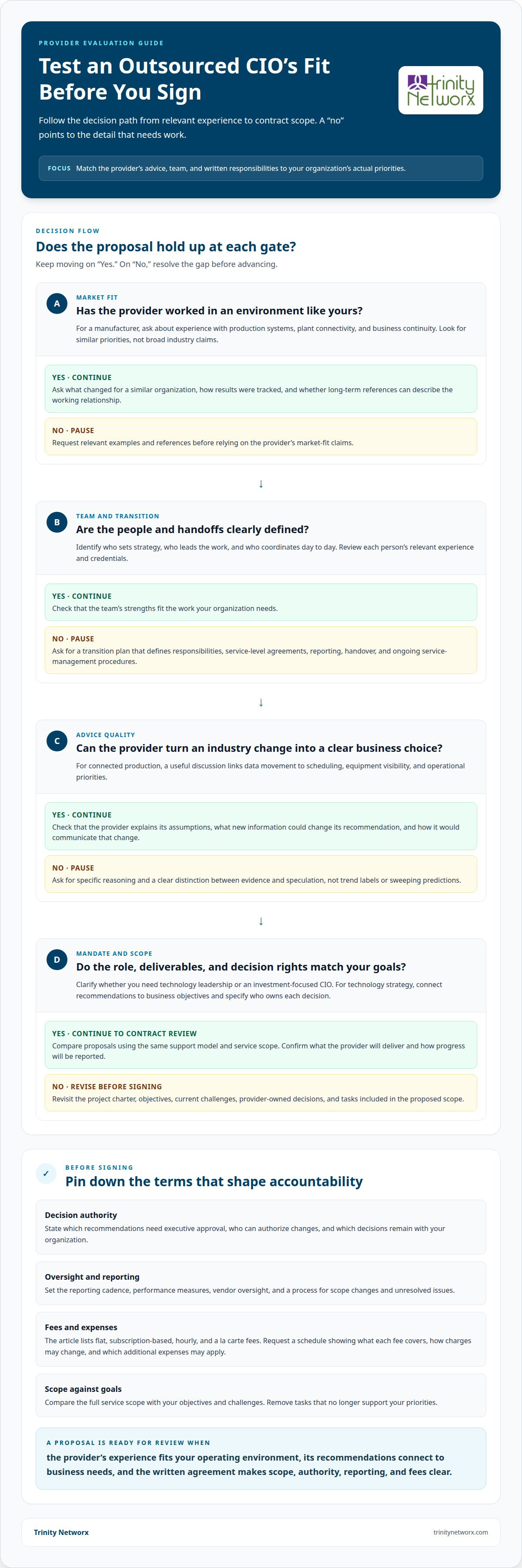
Market fit matters because a provider’s experience shapes how it understands your constraints. A manufacturer, for example, may need technology decisions that account for production systems, plant connectivity, and business continuity. Compare the provider’s experience with your operating environment, organization, and objectives, not just its broad industry claims. A practical way to approach how to choose an outsourced CIO is to examine examples involving similar priorities.
Look for outcomes, not just a list of familiar-sounding clients. Ask how the provider helped a similar organization meet its goals, what changed, and how results were tracked. Then speak with references who have worked with the provider over time. Long-term clients can explain whether its advice remained useful as their operations and needs changed.
An outsourced chief information officer may be supported by a team rather than one person. Identify who sets strategy, who leads implementation, and who handles day-to-day coordination. Review each person’s relevant experience and credentials, then match those strengths to the work your organization needs. When considering how to choose an outsourced CIO, check that the team’s market knowledge fits your operating pressures.
Review implementation experience separately. Ask the provider to explain how it would define the transition project, transfer responsibilities, set service-level agreements and reporting, hand over the service, and establish ongoing service-management procedures. Discuss how each step would work in your environment, including who owns decisions and how the provider will communicate during the transition.
Finally, clarify scope before comparing proposals. For an investment-focused OCIO, ask how it evaluates assets beyond risk and return alone. For technology strategy, ask how recommendations connect to business objectives. Confirm what the provider will deliver, how it will report progress, and what it will charge for each defined service. Those details reveal whether its experience matches the work you need.
Thought leadership is useful when it helps you make a decision. Ask the provider to connect an industry change to a specific business choice and explain the assumptions behind its advice. For a manufacturer, a discussion of connected production should address how data movement could affect scheduling, equipment visibility, and operational priorities. Look for clear reasoning, not trend labels or sweeping predictions.
Test whether the provider revises its view as conditions change. Ask what new information could change a recommendation, how the provider would communicate that change, and how it distinguishes evidence from speculation. Conversations with peers, trade groups, and professional advisers can offer additional perspective on how the provider communicates and adapts. Use those insights to shape focused questions, not replace your own assessment.
A successful transition starts with executive support and written goals. Establish a project charter, define measures of success, and evaluate candidates through structured discussions about your priorities. Once you select a provider, agree on responsibilities, decision channels, and how knowledge will pass between the provider and your team. Assign an internal owner to keep the transition connected to business needs.
Compare proposals against the same support model and service scope. A chief investment officer and a technology leader have different mandates, so clarify which role you need before weighing recommendations. If technology leadership must work alongside day-to-day operations, assess how each provider coordinates with internal staff. To discuss your organization’s IT priorities, connect with our team.
Review the project charter before signing. List your objectives, current challenges, and the decisions the provider will own, then compare each item with the proposed scope. For example, if the goal is stronger production continuity, the agreement should define how technology risks, vendor work, and recovery planning will be monitored. Remove tasks that no longer support your priorities.
Set decision rights in writing. Specify which recommendations need executive approval, who can authorize changes, and how the provider will report progress. For investment management, define whether the outsourced chief investment officer may manage the portfolio, advise a board, or monitor investment managers. Tailor the mandate to your governance structure, and state which decisions remain with the organization.
Fiduciary responsibilities depend on the duties delegated and the organization’s role. Organizations that outsource investment tasks typically retain some fiduciary responsibility, including governance oversight, so the agreement should distinguish provider duties from the organization’s own oversight.
Fees may be flat, subscription-based, hourly, or a la carte. Before signing, request a detailed schedule that explains what each fee covers, how charges may change, and which additional expenses may apply. Compare the total scope, not just the headline fee, and ask how costs relate to assets and services.
Use the contract to set vendor oversight, reporting cadence, performance measures, and a process for scope changes. For a manufacturer, specify who monitors technology vendors and checks their work against operational requirements. Define how concerns are raised, decisions recorded, and unresolved issues escalated. Clear terms establish accountability while preserving your organization’s control.
Ready to align technology goals, responsibilities, and support needs? Discuss your organization’s IT priorities.
Trinity Networx supports organizations where technology interruptions can disrupt production and construction work. In manufacturing, weak wireless coverage between the plant floor and office can leave teams without timely access to operational systems. Commercial structured cabling and fiber optic installations can address physical connectivity gaps, while Managed IT Services support ongoing business technology needs in California, Nevada, Arizona, and Utah.
For an internal IT team that needs added capacity, Co-Managed IT Services can supplement its work. Cybersecurity Solutions and Data Backup & Recovery support security and recovery needs, while your organization retains its strategic leadership decisions.
Contact Trinity Networx, LLC to discuss your organization’s IT priorities and support needs.
The real test of how to choose an outsourced CIO is what happens after the agreement is signed. Set a first review date, name the people responsible for decisions, and give the provider a clear route for raising issues. Keep the plan connected to business priorities as operations change. This discipline grounds technology direction in the work your organization needs to do.
Trinity Networx supports the operational side with Managed IT Services, Cybersecurity Solutions, and Data Backup & Recovery. These services help organizations address day-to-day IT demands while leadership focuses on strategy and oversight.
When you’re ready to map out your organization’s IT needs, start a conversation with Trinity Networx. A clear next step can put your plans in motion.
An outsourced CIO is an external executive or team that provides senior technology leadership without serving as a full-time employee. The role can set technology direction, translate business priorities into plans, and coordinate internal IT and vendors. In investment contexts, CIO can also mean chief investment officer, so define whether the mandate covers organizational technology or investment portfolio management.
Yes. An outsourced CIO may support work beyond technology decisions by coordinating with finance, operations, and other departments on policies, reporting, and workflows. For example, the provider can help align technology systems with purchasing or payroll processes when those functions affect organizational objectives. Clarify in the agreement whether the provider advises, coordinates, or directly manages each task.
An outsourced CIO can reduce costs associated with hiring, training, and paying a full-time executive, but savings depend on the role’s scope and your organization’s needs. Compare the proposed arrangement with the full cost of internal leadership, including management time and the expertise required. Judge value by the decisions and work covered, not by a lower fee alone.
An outsourced CIO guides technology or investment decisions, depending on the mandate. In a technology role, the work may include setting direction, planning budgets, reviewing vendors, and helping leadership weigh priorities. For example, a business entering a new market may need advice on technology capacity and risk before committing resources. Daily technical operations may fall outside the CIO’s scope.
Use the same practical scenario to assess each provider’s approach. For example, ask how they would plan a plant network change while keeping production needs in view. Compare how clearly each explains trade-offs, decision ownership, and dependencies. A simple scorecard can help your leadership team weigh responses against its priorities and record assumptions to resolve before signing.

Article by
Lance Reichenberger, Ph.D.., J.D. (Candidate)
Dr. Lance Reichenberger is the founder of Trinity Networx, a Southern California technology firm specializing in managed IT services, cybersecurity, network infrastructure, and business technology strategy. With nearly four decades of experience in the IT industry, he works with businesses to improve operational efficiency, strengthen security, and align technology with long-term growth objectives.
Lance focuses on proactive IT management, enterprise wireless infrastructure, cybersecurity integration, and scalable technology solutions for growing organizations throughout Southern California.
The content published on this website is provided for general informational and educational purposes only. Articles may be created, edited, or enhanced with the assistance of artificial intelligence and automation tools under the direction and review of Trinity Networx. While every effort is made to ensure accuracy and relevance, the information provided should not be considered professional, legal, financial, cybersecurity, or technical advice specific to your organization. Businesses should consult directly with a qualified professional regarding their unique environment, compliance requirements, and operational needs. Trinity Networx makes no warranties regarding completeness, reliability, or applicability of the information contained within these articles.
Schedule a brief conversation with Trinity Networx to discuss your business technology needs.
Get a practical roadmap built around your business, your users, your systems, and the technology issues that need attention first.
Put the right technology, support, security, and infrastructure in place so your business can grow, adapt, and move forward with confidence.